X

Equitable Mobility List | Summary | Detailed

Alliance for Biking and Walking

2013 - $8,000 Open Streets
2011 - $5,000 General Operating Support
The Alliance for Biking & Walking creates, strengthens, and unites state and local bicycle and pedestrian advocacy organizations.

Alliance for Biking and Walking


Alliance for Biking and Walking

2013 - $8,000 Open Streets
2011 - $5,000 General Operating Support

The Alliance for Biking & Walking creates, strengthens, and unites state and local bicycle and pedestrian advocacy organizations in every state, province, and major city in North America. These sustainable organizations are highly respected by the public, media, and policy makers. Their efforts in communities and their united strength at the national level have transformed cities into places where it is easy, safe, desirable and common for citizens to bike and walk.

Open Streets
Open Streets develops a curriculum for a comprehensive three-day open streets training for cities interested in starting or growing initiatives. Open streets (commonly called Ciclovías, Saturday Parkways, Sunday Streets, etc.) differentiate themselves from block parties and street fairs by promoting active living, healthy lifestyle choices and connecting neighborhoods. They are typically part of a broader effort to encourage sustained physical activity, redefine public spaces and increase healthy transportation options. By opening the streets to people, residents view and connect with the community in a whole new way. An exercise in community building and social engagement, open streets also provide free recreational opportunities and public space where people can meet, socialize and make new friends. peoplepoweredmovement.org

Bedford Stuyvesant Restoration Corporation

2021 - $10,000 Micromobility As a Tool Towards Economic Equality
Based in Central Brooklyn, BSRC is rooted in the largest population of African-Caribbean diaspora in the United States where there is a convergence of economic, health, environmental disparities. Since 2015, Restoration has been a local, city-wide, and national leader in the bike share and micromobility sector.

Bedford Stuyvesant Restoration Corporation


Bedford Stuyvesant Restoration Corporation
2021 - $10,000 Micromobility As a Tool Towards Economic Equality

Bedford-Stuyvesant Restoration Corporation is the nation’s first community development corporation. Created in 1967 through grassroots activism and the bipartisan support of Senators Robert F. Kennedy and Jacob Javits, Restoration serves 50,000 people annually as an advocate, coalition-builder, and direct service provider. Based in Central Brooklyn, BSRC is rooted in the largest population of African-Caribbean diaspora in the United States where there is a convergence of economic, health, environmental disparities. Since 2015, Restoration has been a local, city-wide, and national leader in the bike share and micromobility sector. 

BSRC’s mission is to disrupt and close the racial wealth gap to ensure all families in Central Brooklyn are prosperous and healthy. With a vision of a flourishing Brooklyn community consisting of strong families, businesses, and institutions and anchored in a culture of equity and inclusion, for over a decade their Center for Healthy Neighborhoods (CHN) aims to change the structural conditions that drive the inequities in chronic disease, focusing on policies, systems and environmental change within the food and transportation sectors.  

Since Citi Bike’s further expansion into Bedford-Stuyvesant in 2015, BSRC has led the NYC Better Bike Share Partnership (NYC BBSP) to increase access to and usership of bike share in low-income communities of color in Brooklyn and throughout NYC. Restoration partnered with then Citi Bike operator Motivate, the NYC Department of Transportation (DOT), and NYC Department of Health and Mental Hygiene (DOHMH). The efforts of the partnership has resulted in the expansion of the $5 a month Reduced Fare Bike Share membership option to all SNAP recipients, the Citi Bike for Youth and Prescribe-A-Bike programs, the formation of Lyft’s Equity Advisory Board, and an increase in bike share access among low-income residents by over 77%. 

The work of the NYC BBSP is centered on increasing access to active transportation options thereby, improving access to employment, education and other resources while increasing physical activity options in underserved communities. Ensuring that decisions around policies, investment and infrastructure in low-income areas are made by people with lived experiences in those communities will lead to better services and safer streets. This in turn allows for greater adoption of active transportation, and better access to resources that support health and economic opportunities.

With support from Seed Fund, BSRC is spearheading a multi-pronged initiative to increase employment and business opportunities, as well as representation of people of color from low income communities in decision-making positions within the micromobility sector. To accomplish this BSRC will:

  • Significantly increase the number of low-income people of color with living-wage employment and business opportunities in the transportation and micromoblity industry, as well as their representation in transportation planning fields;
  • Host mentorship programs and create paid fellowships for students from marginalized groups, working with them to develop skills leading to analyst, planning and tech positions;
  • Change recruitment practices within micromobility/transportation planning organizations, modify hiring rubrics and create programs for internal advancement of staff in lower-paid positions;
  • Engage schools and areas with more students of color, and enhance the field’s image to attract a diverse workforce.

restorationplaza.org

Brooklyn Greenway

2025 - $15,000 General Operating Support
2023 - $15,000 General Operating Support
Brooklyn Greenway Initiative (BGI) is committed to the development, establishment, and long-term stewardship of the Brooklyn Waterfront Greenway - a 29-mile protected and landscaped route for pedestrians and cyclists of all ages and abilities.

Brooklyn Greenway


Brooklyn Greenway
2025 & 2023 - $15,000 General Operating Support

Brooklyn Greenway Initiative (BGI) is committed to the development, establishment, and long-term stewardship of the Brooklyn Waterfront Greenway - a 29-mile protected and landscaped route for pedestrians and cyclists of all ages and abilities. When complete, the Greenway will connect Brooklyn’s waterfront, parks, and open space, commercial and cultural corridors, and new tech and innovation hubs for 2.65 million Brooklyn residents, over 1.1 million people who work in Brooklyn, and 15 million annual visitors from across New York City and around the world.

Since its founding in 2004, BGI has channeled more than $218 million in public and private investment toward implementation of the Greenway, leveraged public and private investment of $2.38 million toward the creation of the Naval Cemetery Landscape (NCL) as a new park-like space and memorial meadow adjacent to the Greenway, and conceptualized or supported the development and stewardship of other open spaces and public amenities along the Greenway. BGI hosts numerous public events and programs designed to activate the Greenway and NCL, foster critical support and stewardship for this vital public infrastructure, and build awareness and engagement of BGI as the organization dedicated to their long-term care.

Approximately 21 miles of the Brooklyn Waterfront Greenway are currently complete, and expansion projects are underway. While progress is encouraging, planning gaps remain, and resources for the Greenway’s ongoing maintenance and stewardship are severely lacking. New York City’s pandemic bikeboom (in 2020, bicycle use on the Greenway soared 3-5 times from 2019 and pedestrian use doubled) and increasing extreme weather have made it abundantly clear that the Greenway is essential intersectional infrastructure for public health and wellbeing, active transportation, and resiliency against the changing climate.

Due to the work of BGI and their partners, there is strong momentum to advance greenways in Brooklyn and across New York City. To make progress on this work, BGI is focusing on the following programs in 2024.

New York City Greenways Coalition: In 2021, BGI formed the New York City Greenways Coalition, a group of greenway-aligned partners focused on completion and continual enhancement of an equitable greenway network in New York City. The coalition has successfully advocated for a citywide greenways plan, in addition to federally funded greenway corridor planning across New York City. In the fall of 2024, Brooklyn Greenway Initiative is building support to host their second NYC Greenways Summit - a convening of greenway-invested stakeholders across sectors to share expertise on the need for comprehensive planning, implementation, and upkeep of a fully developed greenway network in NYC. Attendees of the summit will receive a greater understanding of New York’s City transportation policy and clear next steps for influencing policymakers to support greenway infrastructure.

Brooklyn Waterfront Greenway Advocacy, Community Engagement, and Stewardship: The Brooklyn Waterfront Greenway still has 8 miles to go to complete its 29 mile corridor from Greenpoint to East New York. In 2024, BGI will continue to build partnerships to advocate for completion and engage communities across Brooklyn in stewardship activities, bike rides, and other activities to increase awareness and use of greenways.

Brooklyn Waterfront Greenway User Study: To improve the greenway and advocate for completion, BGI needs to better understand who’s using it and how. In March 2023, BGI launched a 13-month study to measure use along 29 miles of the Brooklyn Waterfront Greenway. With our project partners, BGI installed 32 computer sensors along the corridor to measure the volume of use and mode of use (pedestrian, bicycle, skateboard, etc.) for 24 hours each day. In 2024, BGI will publish a report of the user study’s findings, along with fieldwork data that will work to inform the forthcoming Greenways Master Plan and the community based planning efforts happening concurrently. In addition to usership, BGI will have data to demonstrate the environmental impacts of the Brooklyn Waterfront Greenway and on reduced vehicle trips and carbon emissions.

Naval Cemetery Landscape Public Space: This 1.7 acre public space, pollinator meadow, and historic site is a place for respite and community on the Brooklyn Waterfront Greenway. Fully operated and funded through BGI and their supporters, the landscape is open year round for visitors and hosts dozens of public programs every year. Located in a community that is lacking in greenspace, It is a unique natural area and peaceful spot that welcomed over 14,000 visitors in 2023. In 2024, BGI will continue to maintain an expanded schedule of stewardship events to engage community volunteers in greening projects. BGI will work to develop dynamic public programs, events, and engagement opportunities with community, nonprofit, and corporate partners to grow in-person public engagement, education, nature, art, and wellness programs at the Naval Cemetery Landscape and on the Greenway.

More information about Brooklyn Greenway Initiative is at: brooklyngreenway.org; and the NYC Greenway Coalition, created and maintained by BGI, is here: greenways.nyc.

brooklyngreenway.org

California Bicycle Coalition

2023 - $15,000 Climate Action Plan for Transportation Infrastructure
2021 - $10,000 Engaging with California Action Plan for Transportation Infrastructure (CAPTI)
2020 - $15,000 Toolkit for Temporary Road Closures/ Biking During COVID-19 Pandemic
2019 - $15,000 & $10,000 General Operating Support
The California Bicycle Coalition Education Fund (CalBike) advocates for equitable, inclusive, and prosperous communities where bicycling helps to enable all Californians to lead healthy and joyful lives.

California Bicycle Coalition


California Bicycle Coalition
2023 - $15,000 Climate Action Plan for Transportation Infrastructure
2021 - $10,000 Engaging with California Action Plan for Transportation Infrastructure (CAPTI)
2020 - $15,000 Toolkit for Temporary Road Closures/ Biking During COVID-19 Pandemic
2019 - $15,000 & $10,000 General Operating Support

The California Bicycle Coalition Education Fund (CalBike) advocates for equitable, inclusive, and prosperous communities where bicycling helps to enable all Californians to lead healthy and joyful lives. 

CalBike is guided by a vision of California where:

  • Public spaces, especially our streets, are safe, appealing, and accessible for Californians of every economic status, race, gender, immigration status, or ability.
  • Communities are prosperous, whether rural, urban, or suburban, and all Californians enjoy a high quality of life and freedom from poverty, violence, and oppression.
  • California's communities are able to invest in affordable housing safely connected on foot or by bike to the places we learn, work, play, and access healthcare.
  • Our cities build convenient and affordable public transit networks.
  • Decisions about transportation in California are made by those who are most impacted and burdened by our current system. Low-income communities and communities of color no longer bear the greatest burdens of the environmental and public health and safety impacts of transportation.
  • Bicycling is loved and appreciated by everyone for its role in supporting prosperity, health, safety, and joy that all Californians benefit from.

Since 1999, CalBike has promoted sustainable transportation and healthy communities. They have organized trainings, conferences, workshops and direct support for bicycle and equity advocates, sharing best practices with local and state-level leaders. They have created toolkits and how-to guides to give local leaders the information they need to implement great bicycle infrastructure. They have succeeded in pressing Caltrans to greatly increase bike/walk infrastructure funding. They have shaped state-level guidelines to encourage protected bike lanes and intersections, making California a leader in the kind of people-friendly street design that encourages bicycling among people of all ages, cultures, genders, and income levels.

CalBike's focus is on the intersection of social justice and sustainable transportation, and their policy team works to redress the discriminatory transportation policies that have divided and polluted California's disadvantaged communities, especially where those policies have disadvantaged people who ride or want to ride bicycles. To that end, CalBike has succeeded in shaping grant guidelines and priorities to ensure that a majority of state bike/walk funds go to disadvantaged communities. They have pushed Caltrans to use highway maintenance funds to build Complete Streets, streets that serve all users, and pressed them to devote more safety funds to biking and walking, along the state highways that often serve as main streets in disadvantaged communities. They work with local community advocates in disadvantaged communities, offering training to help them access bike/walk infrastructure funding. They have worked to connect BIPOC transportation advocacy leaders with the skills and knowledge to effectively promote sustainable transportation policy, and to bring representation of BIPOC communities to the halls of power, including the California Transportation Commission. 

CalBike works closely with advocates across the state and in Sacramento, collaborating with them on intersecting issues such as pedestrian access, transit and housing.

CalBike projects the Seed Fund is supporting in 2020-2021.

Complete Streets
All roads in California should be safe and inviting for people of all ages and abilities to bike, walk, or ride public transit. That’s the vision for CalBike’s Complete Streets Campaign. After significant pressure, Governor Newsom and Caltrans leadership have stated support for Complete Streets, and promised to implement them where appropriate. However, Caltrans has in the past instituted but failed to implement good Complete Streets policies. CalBike is acting as a watchdog, holding Caltrans and the governor accountable to their stated promise to prioritize Complete Streets. 

Changing the Conversation Around Climate and Transportation
Currently, the state-level conversation about reducing transportation sector carbon emissions focuses on the transition from gas cars to electric ones. While this transition is necessary, it is insufficient to address the climate crisis, and ignores as well the hopeful possibilities for a just climate transition that includes and lifts up low-income people and people of color. CalBike works to influence policymakers and environmental organizations to ensure that bicycling, walking, transit, and in-fill housing are part of the conversation.

Shared Micromobility for Everyone 
CalBike is working to save bike and scooter share from the unsustainable profit-centered model. They work to integrate public shared mobility into public transit systems so that users may access bikes and scooters on the same terms and in the same manner as public transit. Whether through a purely public service or a public-private partnership, this kind of support and integration is essential to accomplishing our goal of affordable and healthy mobility for all Calfornians, including those who live in low-income neighborhoods. 

Quick-Build Toolkit and "Slow Streets" How-To
CalBike created two guides to respond to the increase in bicycling under the pandemic. The Slow Streets How-To Guide offers communities best practices on how to implement Slow Streets-streets closed to through traffic, where people walking and biking can have plenty of room to have fun, get exercise, and get where they need to go safely. CalBike's Quick-Build Toolkit, created in partnership with Alta Planning + Design, is a comprehensive guide to quick-build bicycling infrastructure. Quick-build is a method of building bike and pedestrian safety improvements-protected bike lanes, pedestrian crossings, slow streets, parklets, and more-now, within a tight budget. In challenging times, quick-build projects are crucial to building trust in the government’s ability to deliver public benefit. And quick-build infrastructure can engage the public better than ever, and be more inclusive and equitable than traditional infrastructure. With support from the Seed Fund and in collaboration with Alta, CalBike created a 4-page brochure to convince policymakers to push for quick-build. The full 77-page Toolkit tells city planning departments step by step how to implement quick-build projects.

Emergency COVID Bicycling Resources
CalBike quickly responded to the pandemic and the resulting surge in bicycling with a host of online resources for those new to bicycling, as well as people who were already biking but had questions about how to ride safely under COVID.

calbike.org

Center for Creative Land Recycling

2012 - $5,000 San Francisco Blue Greenway Project
2010 - $5,000 San Francisco Blue Greenway Project
The Center for Creative Land Recycling encourages environmentally conscious and socially responsible development through the facilitation of land recycling.

Center for Creative Land Recycling


Center for Creative Land Recycling
2010 & 2012 - $5,000 San Francisco Blue Greenway Project

The Center for Creative Land Recycling (CCLR) is a nonprofit organization focused on creating sustainable communities and encouraging environmentally conscious and socially responsible development through the facilitation of land recycling. Their work is founded on the belief that the creative reuse of already used lands, (often environmentally-distressed properties, commonly referred to as “brownfields”) is the key to responsible land use and sustainable development. This is accomplished through training, technical assistance and funding for communities who are attempting to turn around vacant or environmentally distressed properties through creative private, public, and nonprofit partnerships.

The San Francisco Blue Greenway is a 13-mile long corridor along San Francisco’s southeastern waterfront that will link established open spaces; create new recreational opportunities and green infrastructure at brownfield sites and in brownfield impacted areas; provide public access through the implementation of the San Francisco Bay Trail, the San Francisco Bay Water Trail, and green corridors to surrounding neighborhoods; increase neighborhood vitality through connectivity; install public art and interpretive elements; support stewardship; and advocate for full waterfront access as an element of all planning and development processes throughout southeastern San Francisco.

CCLR is assisting the San Francisco Parks Alliance (formerly the Neighborhood Parks Council) in navigating the brownfields process to design and develop parks along the Blue Greenway.

cclr.org
bluegreenway.org

Climate Ride

2024 & 2025 - $9,000 General Operating Support
2022 & 2023 - $8,000 General Operating Support
2019 to 2021 - $6,000 General Operating Support
2015 to 2018 - $3,000 General Operating Support
Climate Ride organizes bike rides and hikes all over the world to encourage riders to raise vital funds and awareness for climate related organizations.

Climate Ride


Climate Ride
2024 & 2025 - $9,000 General Operating Support
2022 & 2023 - $8,000 General Operating Support
2019 to 2021 - $6,000 General Operating Support
2015 to 2018 - $3,000 General Operating Support

Founded in 2008, Climate Ride is nonprofit that transforms outdoor adventure into a powerful engine for environmental philanthropy. By organizing multi-day cycling, hiking, and running events, the organization empowers individuals to tackle personal challenges while raising critical funds for sustainability, active transportation, and climate justice.

Climate Ride addresses the historic underfunding of the environmental sector by bridging the gap between advocacy and sport. Participants engage their personal networks to amplify awareness, turning every mile traveled into a catalyst for community-based activism. This unique model allows participants to direct the funds they raise to a diverse roster of beneficiaries working on clean energy, public health, and sustainable infrastructure.

The impact of this movement is significant. Since its inception, more than 3,600 participants from 47 states and 12 countries have raised over $6.2 million for environmental causes. These grants have supported high-stakes legal battles for clean air, funded renewable energy projects in National Parks, and expanded safer pedestrian and cycling networks. Beyond the financial contributions, Climate Ride fosters long-term behavioral change; for many, a single event evolves into a lifetime of advocacy, as seen in supporters who have personally raised tens of thousands of dollars to safeguard the planet.

Even when faced with global challenges such as the COVID-19 pandemic, Climate Ride remained resilient by launching virtual initiatives like Climate Rise, which mobilized hundreds of new advocates. Through its Community Leaders awards and events like the Green Fondo, the organization continues to diversify the environmental movement, ensuring that the next generation of sustainability leaders has the resources and community support needed to drive lasting policy change.

climateride.org

Critical Mass

2012 - $5,000 20th Aniversary Celebration
Critical Mass started in September 1992 in San Francisco as a way to bring cyclists together in a festive re-claiming of public space.

Critical Mass


Critical Mass
2012 - $5,000 20th Aniversary Celebration

Critical Mass got started in September 1992 in San Francisco as a way to bring cyclists together in a festive re-claiming of public space. Beginning rather under a less catchy name-the Commute Clot-the ride drew an initial crowd of 60 cyclists, and these numbers doubled for several months following.

Critical Mass has continued and grown in San Francisco, drawing hundreds from month to month, with typical rides around 1,500 to 2,000 (an all-time high on the 2002 10th anniversary is rumored to have been 10,000 cyclists!), but it has spread to over 300 other cities as well. For example, two dozen Italian cities have vibrant Critical Masses now, with Rome leading the way. In 2012, bicyclists in Brazil staged Critical Masses in over 20 cities to dramatize a surge of cyclist deaths in that country's car-centric streets. With independent rides springing up all over the place, Critical Mass has begun to take on the character of a large scale, decentralized grassroots movement!

September 2012 celebrates 20 years since the first Critical Mass took place in San Francisco.  A week long series of events and rides are planned.  The Seed Fund grant will support documentation of the events including a publication and original poster and sticker art.

sfcriticalmass.org

Cycles of Change

2021- $10,000 General Operating Support
Cycles of Change works to improve the health and sustainability of East Oakland neighborhoods by increasing the use of bicycles as transportation.

Cycles of Change

A Cycles of Change staff member distributing helmets to Upcycle class participants

Bike Clubs students riding in the Oakland Hills

Upcycle class participants with their new bikes and helmets

Cycles of Change educator explaining helmet fit to elementary school students

Community members gathered outside of The Bikery

A Cycles of Change educator demonstrating how to test the brakes on a bike before riding

Bikery mechanics working in the shop!


Cycles of Change
2021- $10,000 General Operating Support

Mission:

Cycles of Change works to improve the health and sustainability of East Oakland neighborhoods by increasing the use of bicycles as transportation. Cycles broadens access to biking in low-income communities of color through education programs and low cost or free resources, and connects youth with the extraordinary living ecosystems of their local area to build a diverse community of visionary young leaders.

History:

Cycles of Change is deeply rooted in East Oakland. Starting in the basement of Roosevelt Middle School in 1998, a small-but-mighty staff of 3 led young riders on after-school bike adventures and offered them opportunities to earn bikes. These programs became wildly popular and developed a huge following. Since then, the organization has expanded to offer in-school bicycle safety trainings and adult commuter programs for low income Oakland residents, as well as in 2009 opening The Bikery, a community bike shop making biking more accessible for all kinds of riders.

Through these endeavors, Cycles of Change has built deep, multi-generational relationships in East Oakland and the East Bay with schools, community-based organizations, and families throughout Alameda County. Cycles lifts up East Oakland youth and families with a multi-pronged approach including after-school Bike Clubs, in-school bike safety classes, high school mentorships, and youth job training and employment.

Vision:

Climate Justice: Cycles of Change envisions a world in which everyone has access to clean air, water, and nature. This vision is currently far from reality, as East Oakland residents are impacted every day by environmental racism baked into Oakland’s geography. Cycles of Change works to increase bike ridership and minimize reliance on cars, empowering local residents and growing access to the natural world through pedal-powered adventures to public greenspaces and ecosystems in East Oakland.

Affordable Mobility: Cycles of Change believes that every resident of the San Antonio district and East Oakland should have access to bikes, because flexible, affordable mobility boosts residents’ quality of life and grows their agency over the spaces in which they live. Through The Bikery, a community bike shop located at 23rd Ave and 12th Street, Cycles of Change seeks to make this dream a reality. For eleven years and counting, The Bikery has been an indispensable resource for community members, providing sliding-scale and pro-bono bikes and repairs to over 1,000 customers a year, facilitating high school internships and earn-a-bike programs, and serving as a hub of community for local youth to socialize and learn bike mechanics.

Values:

Equity: Cycles of Change works with an equity lens, believing strongly in a holistic framework of Transportation Justice at the urgent intersection of movements for racial, gender, economic, environmental, and disability justice. Currently, the organization is fully comprised of educators and advocates of color, committed to bold solutions in communities most impacted by climate change and environmental racism.

Collective Governance: Cycles of Change believes in shared knowledge and uses a democratic decision-making process and horizontal organizational structure that makes space for many voices. Cycles of Change commits to restorative justice and harm-reduction approaches to conflict management that do not involve law enforcement or the carceral state.

Programs:

  • The Bikery - a community bike shop offering sliding scale prices and affordable mobility for the community. The Bikery serves over 1,000 community members per year, connecting local residents with affordable transportation and serving as a hub of community while also offering youth job training, employment, and mentorship.
  • Upcycle - a class for low-income adult commuters and families that promotes access and ridership. Upcycle currently runs an average of one class a month, equipping participants with comprehensive bike riding education, a free bike, helmet, lock, and lights, so they are able to incorporate riding into their daily lives for utility and recreation.
  • Bike Clubs - an afterschool program building leadership and community at East Oakland middle and high schools. Bike Clubs run out of four Title I schools, leading students on pedal-powered adventures through East Oakland landmarks. Bike Clubs educate students on riding and mechanics, urban geography, and environmental science, while growing their agency over the neighborhoods in which they live.
  • Safety Program - an in-school bike education program serving over 5,000 students each year throughout Alameda County. The Safety program brings experiential learning to students all over the East Bay, allowing thousands of young people to learn to ride a bike or deepen their knowledge and continue their bike journey.

Community Voices:

“It feels amazing to be riding in the city I live in. It feels good because you put more force into it [compared to a car] and you get to exercise more.” --Sarayha (2021 MetWest Huerta Bike Club) 

“Learning to ride a bike feels really great because I can ride whenever I want now. I get to see places I’ve never been before, and I really like feeling the wind while I’m riding.” --Quennie (2021 MetWest Huggins Bike Club)

cyclesofchange.org

Great Communities Collaborative

2022 - $25,000 General Operating Support
The Great Communities Collaborative (GCC), launched in 2005, is a multi-sector initiative housed at San Francisco Foundation that engages local organizations in shaping the future of housing, transportation, regional land use, and climate resilience in the nine-county Bay Area.

Great Communities Collaborative

Urban Habitat's report Regional Resegregation: Building Power in the Suburbs, November 2022. Credit: Urban Habitat

When Concord City Council finally took action to pass an Anti-Harassment Ordinance after tenants and housing advocates organized and demanded for one, the city drafted an ordinance with language that was going to hurt tenants rather than protect them. In response, tenants and housing advocates organized an action at Concord City Council chambers to demand passage of an ordinance to protect tenants from further harassment by their landlords. May 2022. Credit: Monument Impact

Youth leaders of the North Bay Organizing Project’s Latinx Student Congress gather cultural foods at Bayer Farm in Santa Rosa to prepare a shared meal at the annual Academia del Pueblo 2022 summer training program. Credit: North Bay Organizing Project.

Monument Impact staff gave public comments to Concord City Council in favor of passing tenant protections such as rent stabilization and just cause for eviction within Concord's Housing Element plan. They also advocated for for affordable housing to be built across all of Concord, not just particular areas, to stop the ongoing gentrification and displacement of Concord families. January 2023. Credit: Monument Impact.

Leaders of the North Bay Organizing Project’s Sonoma County Tenant’s Union facilitate a general meeting and training of a grassroots base of tenants across Sonoma County. Credit: North Bay Organizing Project.

Leaders of the North Bay Organizing Project discuss and train each other in organizing principles at an annual strategic planning convening. Credit: North Bay Organizing Project.

Urban Habitat's State of the Region event, November 17, 2022, panel on Creating an ecosystem to take land and housing off of the speculative market, with Noni Session, EBPREC; Somaya Abdelgany, BAHFA; and Valerie Jameson, Richmond LAND as speakers and moderated by Chris Norman, Oakland HCD. Credit: Urban Habitat.


Great Communities Collaborative
2022 - $25,000 General Operating Support

The Great Communities Collaborative (GCC), launched in 2005, is a multi-sector initiative housed at San Francisco Foundation that engages local organizations in shaping the future of housing, transportation, regional land use, and climate resilience in the nine-county Bay Area.

The Great Communities Collaborative convenes funders, public sector agencies, elected officials, and nonprofit organizations through the GCC Funders Network and multiple working groups. Together we envision and advance a racially equitable, economically inclusive, and environmentally sustainable Bay Area with thriving neighborhoods that are well connected to regional opportunities and affordable for people of color and underpaid workers. We also help protect people’s ability to stay in their homes, preserve existing affordable housing, and promote the production of new affordable housing, especially on public lands.

By involving more people in planning and decision-making about their neighborhoods, GCC helps bring a diversity of voices into conversations around the future of our cities, counties, and the Bay Area as a whole, leading to new policies and practices around regional planning. They tackle regional inequities by collaboratively funding efforts that:

Champion Racial Equity: Great Communities Collaborative works to ensure that marginalized communities - which are often predominately made up of Black, Indigenous, and other people of color - are involved in decision making around housing, transportation, land use, and climate resilience, to drive outcomes that promote racial equity and economic inclusion. Great Communities Collaborative produced a report in March 2022 called Five Ways Philanthropy Can Catalyze Tenant-Centered Housing Preservation with LISC Bay Area and San Francisco Foundation, which outlines how the pandemic has disproportionately affected the housing stability of people of color, and how to preserve housing through a tenant-centered lens to achieve equity.

Center  Impacted People: Great Communities Collaborative funders, partners, priorities, program areas, and strategies center Black, Indigenous, and people of color communities who have experienced and are experiencing the harshest impacts from historical and systemic racial discrimination and economic marginalization. We believe that the people most impacted by inequities should be involved in designing their own solutions, so we strive to center their expertise, be guided by their lived experiences,  amplify their voices, advance their solutions, and position them as leaders for outreach, education, and advocacy efforts, including engaging with policymakers.

GCC funded local organizing through the Silicon Valley Rising Coalition, which includes many labor and community organizations. The coalition gathered community input through three town hall meetings and a community survey. GCC also funded a research study to quantify the impact of the proposed Google campus on the surrounding area, which gave advocates the necessary data to push for greater commitments around affordable housing. The Silicon Valley Rising Coalition ultimately achieved a landmark $200M community benefits agreement from Google in 2021 for downtown San Jose, which included $150M for affordable housing and community stabilization.

Change Policies and Systems: As a multi-sector network of organizations and agencies, the very purpose of Great Communities Collaborative is to bring people together to share, learn, and find solutions to some of the Bay Area’s most pressing problems. GCC was involved in passing AB 1486 to build a regional “Public Land for Public Good” framework to get more Affordable Housing built on public land. As a result, 75% of new affordable housing in San Mateo County will now be built on public land. GCC helped launch two housing loan funds at the Metropolitan Transportation Commission (MTC) - the $40M Bay Area Transit Oriented Affordable Housing Fund (TOAH) and the $49M Bay Area Preservation Pilot (BAPP). Both funds prioritize projects that will create affordable housing for people of color, low-income people, and marginalized communities. We promote policy solutions because they can transform the root causes of our state’s inequality crises. These inequalities are rooted in policies and practices that, collectively, we have the power to change.

greatcommunities.org

Manzanita Works

2021 - $10,000 Bike loaner feasibility program

Manzanita Works

Manzanita Works
2021 - $10,000 Bike loaner feasibility program

Marin County Bicycle Coalition

2020 - $10,000 Funding for More Emergency Bike Lanes During COVID- 19 Pandemic
2019 - $15,000 General Operating Support
2018 - $20,000 The Alto Tunnel Project

Marin County Bicycle Coalition


Marin County Bicycle Coalition

2020 - $10,000 Funding for More Emergency Bike Lanes During COVID-19  Pandemic
2019 - $15,000 General Operating Support
2018 - $20,000 The Alto Tunnel Project

MCBC General

Marin County Bicycle Coalition’s mission is to promote safe bicycling for everyday transportation and recreation. MCBC sees the bicycle as a vehicle for change capable of making Marin’s communities happier and healthier by improving air quality and public health, and reducing traffic congestion.

MCBC has been a leader in bicycle advocacy at the local, state, and national levels since 1998. Using a two-pronged approach to promote bicycling, MCBC teaches children and adults how to ride responsibly and safely, while also advocating for the infrastructure improvements needed to make bicycling a safe and convenient option in all of Marin County.

As part of a new 5-year Strategic Plan, MCBC’s goal is to create a bicycle-centric Marin and build the power and influence of MCBC across all of this county’s communities. In order to make bicycling a viable option for the thousands of Marin residents who are able to bike but experience hurdles, MCBC is exploring how to promote and overcome obstacles to bicycling for transportation through outreach and engagement strategies. This work will focus on addressing the transportation needs and barriers in communities of concern that will be most impacted by severely reduced transit service, including Marin City, San Rafael, and Novato.

MCBC is advocating to make bicycling safe and convenient for people of all ages and abilities. With a goal to share the joy and benefits of bicycling for transportation and recreation with new and emerging riders, MCBC is adding several exciting programs targeting women, children, BIPOC, and underserved communities over the next five years.

Program/Funding Updates

Several programs that have benefited from Seed Fund’s support include advocating for Slow Streets during Shelter-in-Place in 2020, supporting community ambassadors in “Communities of Concern” in Marin, and spearheading the advocacy effort to complete the North-South Greenway with the Alto Tunnel Project.

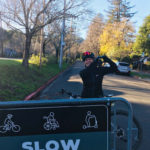
During Shelter-in-Place in early 2020, MCBC promoted and suggested ways in which each jurisdiction in Marin might repurpose streets, and provided technical assistance to those that were interested in opening streets to pedestrians and people on bicycles. MCBC also took this opportunity to promote the quick-build approach to creating bicycle and pedestrian infrastructure, as well as the simplicity and effectiveness of “open streets.”

Many downtowns around Marin went car-free to create space for people to dine outdoors. Nearly all of Marin’s cities and towns approved ordinances allowing businesses to expand operations into adjacent public spaces, including on and off-street parking. As a result, families arriving to town centers by bike experienced a heightened quality of life, especially important during the Shelter-in-Place. Several towns including Novato, San Rafael, San Anselmo, Tiburon, and Sausalito went a step further and completely closed portions of their main streets to cars weekly for the entire summer.

Alto Tunnel Project

Since its founding in 1998, MCBC has been instrumental in building the political will and securing the funding needed to close several gaps along the North-South Greenway. Alto Tunnel is now the highest priority project within the Greenway.

Alto Tunnel is the lynchpin of the North-South Greenway, a regional connection that will make bicycling a safe and convenient option for people who live, work, and visit Marin and Sonoma Counties. When reopened, it will greatly enhance the ease with which people can bike between Central and Southern Marin, and by extension, San Francisco.

MCBC continues to work with and guide community-based group Friends of Alto Tunnel (FOAT) to champion this effort. MCBC is committed to providing FOAT with support through technical assistance, strategic guidance, and community outreach assistance en route to building the remaining political support needed to pursue federal, state, and regional funds for the project.

MCBC has always known that reopening the tunnel would require a sustained and resolute effort. With no studies remaining, the advancement of the project is at a critical juncture. MCBC is now looking to win political support--thereby moving toward implementation--by catalyzing neighborhood-level discussions aimed at 1) demonstrating the tunnel’s value, 2) answering financial questions, and 3) addressing neighborhood concerns.

The Seed Fund’s support is enabling MCBC's community outreach coordination and strategic guidance by 1) aiding in the recruitment, training, and mobilization of neighborhood representatives, and 2) assisting with the facilitation of community workshops, walking tours, and listening sessions aimed at addressing and mitigating concerns related to neighborhood impacts.

Perhaps more importantly, though, the community engagement work enabled by the Seed Fund is helping this project to serve as a national model in building grassroots support for visionary bicycle and pedestrian projects that face local resistance due to high capital costs and perceived neighborhood impacts.

marinbike.org

New Yorkers for Transportation Equity

2025 - $20,000 General Operating Support
New Yorkers for Transportation Equity (NYFTE) organizes towards a transportation network for everyone in New York State that is accessible, dependable and sustainable.

New Yorkers for Transportation Equity

New Yorkers for Transportation Equity
2025 - $20,000 General Operating Support

New Yorkers for Transportation Equity (NYFTE) organizes towards a transportation network for everyone in New York State that is accessible, dependable and sustainable. Their work elevates the voices and perspectives of those most directly impacted: Black and Brown folks, low-income people, immigrants, young people, seniors and people with disabilities. By building the power of walkers, riders and drivers, NYFTE aims to connect all New Yorkers across transit routes, regions and social class. The coalition is led by a Steering Committee of eleven grassroots organizations and 35 partner organizations all across the state.

NYFTE came together in 2023 as billions of dollars were being directed to New York State through the Bipartisan Infrastructure Act. As funds were overwhelmingly going to highway projects, NYFTE wanted to reform this “business as usual” approach and push New York to meet the demands of the state’s ambitious climate plan by diverting transportation spending away from wasteful highway projects and into safe, reliable, accessible, and interconnected public transit, cycling, and pedestrian infrastructure for all who call New York State home. Transportation is the second largest source of carbon emissions in New York State, and highways disproportionately cause higher rates of air and noise pollution in Black and immigrant communities due to the racist history of highway expansion in New York. 

To address these issues holistically, NYFTE is currently fighting for fully funding non-MTA public transit systems in New York State, where wait times can be as long as one hour and buses run less often. Public transit is the most affordable way to get around, and investing in improving these systems would result in sustainable jobs and economic development. NYFTE is also advocating to stop highway expansions that will increase environmental and health risks to disadvantaged communities, and instead pass the Get Around NY Act, which will set targets to reduce vehicle miles traveled (VMT) to meet New York’s climate laws and direct those funds to multimodal transportation instead. To have a safer, healthier and cleaner New York, NYFTE is fighting to not only block polluting infrastructure, but set long-term goals to build New York’s sustainable and public transportation networks instead. 
With roots in Buffalo, Rochester, the Hudson Valley, New York City and Long Island, organizations are building grassroots power by aligning local transit and highway fights with statewide demands. Organizers are also engaged in narrative change work by sharing transit stories and shifting the discourse around transportation equity.

actionnetwork.org

Open Plans

2025- $20,000 General Operating / Filmmaking support
2024- $20,000 Congestion Pricing
2024- $3,000 General Operating Support
2023- $15,000 General Operating Support
Open Plans works to foster a more connected relationship between New Yorkers, their streets, and their city government.

Open Plans

The Building Blocks program guides neighborhoods through the process of envisioning, and then implementing, community-minded changes to their streets

Open Plans summer interns work with a mentor to complete a concentrated project at the end of their internship, culminating in a presentation to staff, fellow advocates and city officials

Director of Advocacy and Organizing Jackson Chabot gives Curbside Climate Award at Open Plans' first-annual Public Space Awards

Awardees and attendees cheer for 34th Avenue Open Street in Queens at Open Plans' first-annual Public Space Awards

Co-Executive Director Sara Lind speaks at rally for safe streets legislature

Emily Chingay and Sabina Unni connect with community at family event

Family music event on Manhattan's Upper West Side

StreetopiaUWS leads neighborhood walk with City Council candidates and local residents during a recent election cycle

Community engagement on Open Streets offer New Yorkers a chance to think creatively about their neighborhood

Open Plans' Emily Chingay shares School Streets toolkit at community event

Co-Executive Director Sara Lind leads Rally to Plan for People, Not Parking

The Building Blocks program guides neighborhoods through the process of envisioning, and then implementing, community-minded changes to their streets


Open Plans
2025- $20,000 General Operating / Filmmaking Support
2024- $20,000 Congestion Pricing
2024- $3,000 General Operating Support
2023- $15,000 General Operating Support

Founded in 1999 as a nonprofit organization dedicated to making New York City more livable, Open Plans works to foster a more connected relationship between New Yorkers, their streets, and their city government. In its early years, the organization focused on developing mapping tools as a way to analyze the issues that affect New Yorkers on a block-by-block basis. Using the information gathered, the organization began to not only map the issues but develop and propose solutions. Topics included public transportation; the use of streets as spaces for community gathering, neighborhood celebration, and events; public safety challenges caused by car dominance; lack of infrastructure for micromobility and pedestrians; and the desire for more equitable access to accessible, safe, public spaces.

In 2004, Open Plans launched Streetfilms, a project that produces and publishes short films highlighting best practices for transportation systems and public spaces around the world. These informative, playful, and inspiring films continue to fuel advocacy efforts today -- and garner huge wins the world over, including the launch and expansion of a robust protected bike lane network in New York City, bike access across the Queensboro and Brooklyn Bridges and complete redesigns of iconic areas such as the Meatpacking District in Lower Manhattan. 

In 2006, Open Plans launched Streetsblog, a daily news source providing deep dives and insider scoops, chronicling the transportation and livable streets scene in New York City and beyond. Inspiring offshoots in many of the major cities in the United States, Streetsblog has become a one-stop shop for all the news that’s fit to discuss regarding transportation, policy, planning, advocacy, budgets, and more. Its readership includes hobbyists, urbanism professionals, and city officials alike. From their annual Parking Madness awards to their recent coverage of the fight for safe and equitable public spaces for all, including the right to protest and the rights of delivery workers, Streetsblog is always on the cutting edge. 

In 2008 and 2009, Open Plans launched the New York City Streets Renaissance Campaign, in collaboration with Transportation Alternatives and Project for Public Spaces. This campaign challenged the auto-centric policies that create congested and unsafe, inhospitable streets. This work led to the first protected bike lanes in New York City, along 9th Avenue in Chelsea, along with years of streetscape changes on the Upper West Side. 

Between 2010 and 2015, Open Plans built on their success and merged their tech and advocacy foci, working with municipalities on tools for mapping and advocated for open source data tools for people to engage with their communities. The organization created maps allowing people to indicate issues in their neighborhoods, specifically around mobility and public space. Working with schools became a major focus; a new education and advocacy arm of the organization taught students how to identify safety issues on their commutes to school and empowered them to navigate their paths more safely. This work often led to students learning more about urban design and civics. Through drawings, petitions, and letters, students spoke at community boards and even engaging with elected officials, learning the power of civic engagement.

By late 2018, StreetopiaUWS was created to reinvest in Open Plans’ long-standing work in the Upper West Side neighborhood of Manhattan. Rooted in grassroots advocacy, Streetopia’s debut campaign was launched to educate people about public space management and start advocating for the city to care for public spaces, especially in residential areas. Today the place-based project works intimately with Upper West Side residents, decision makers, and other stakeholders to achieve safer bike routes and promote a people-centered mindset to placemaking and planning.

The Covid-19 pandemic created unprecedented challenges for New York City but ushered in a new era for Open Plans. As the city was forced to repurpose space for safe, outdoor public gatherings, many guiding principles of livability and people-centered space became commonplace. Suddenly, congested streets were transformed into car-free community space; curb lanes once relegated to parking were transformed into business-saving outdoor cafes. Open Plans seized on this spirit of innovation and gained momentum. The new Open Streets program offered a first-ever opportunity for communities to reprogram their streets for strolling, playing, dancing, and learning - and led to Open Plans’ campaign for a central Office of Public Space Management that would care for and invest in these burgeoning spaces as city services. The organization hired new policy expertise and pursued systemic change in city government while connecting directly with communities at the grassroots level.

This dual focus, with Streetsblog and Streetfilms creating compelling media, is a hallmark of Open Plans’ unique approach. Today, Open Plans continues to grow its nimble and focused staff. With a focus on advocacy, journalism, and inspiring film, Open Plans is illuminating new possibilities and creating meaningful change for every resident of New York City.

openplans.org

People for Bikes

2019 - $12,000 Biking Toolkit for Scoring Cities
The PeopleForBikes Foundation is a national, 501(c)(3) non-profit organization with the mission of putting more people on bicycles more often and making bicycling better for everyone.

People for Bikes

Better Bike Share Partnership - Philadelphia Indego System; credit Joshua Mallory


People for Bikes
2019 - $12,000 Biking Toolkit for Scoring Cities

The PeopleForBikes Foundation is a national, 501(c)(3) non-profit organization with the mission of putting more people on bicycles more often and making bicycling better for everyone. PeopleForBikes Foundation programs include PlacesForBikes, helping to build connected networks of bicycle infrastructure in U.S. cities through initiatives including the Final Mile, City Ratings and Advocacy Academy; the Better Bike Share Partnership, a grant-funded collaborative to improve access to and use of shared micromobility systems in low income and communities of color; the PeopleForBikes campaign, a powerful national movement of people who ride bikes and want riding to be safer, more comfortable and more accessible; and Ride Spot, a platform to help people find and share great places to ride. 

Since its beginning, PeopleForBikes has been dedicated to helping cities, regions and advocacy organizations at the local and state levels advance, promote and build safe places to ride a bike. In recent years, this focus on infrastructure has been reflected through three integrated initiatives: Final Mile, City Ratings and Advocacy Academy. 

Final Mile is accelerating the installation of complete mobility networks in five U.S. cities: Austin, Denver, New Orleans, Pittsburgh and Providence. By combining proven advocacy strategies with public communication tools, this effort builds broad support for new, cost-effective mobility networks. In each city network will increase bike riding and reduce single occupancy motorized vehicle trips. The Final Mile matches investments in mobility infrastructure made by its partner cities with support for specific needs identified by those cities. The program also provides a suite of additional resources including public opinion research, paid communications outreach through digital, broadcast and print media, and support for outreach and engagement activities through local non-profit organizations. The Final Mile cities will complete increases to their mobility networks of between 50 and 150 miles by the end of 2022. 

City Ratings is a data-driven approach to evaluating more than 600 U.S. cities based on the connectivity of their bicycle networks and the experience of riding for those who live there. Using feedback from everyday bike riders, city staff, open-source maps and publicly available data, each city receives a score from 1-100. Detailed maps from the Bicycle Network Analysis tool helps leaders and staff pinpoint areas for improvement so that investments in infrastructure are leveraged for maximum benefit to the people who use it. 

Advocacy Academy is an online video and resource library for city leaders, decision makers and advocates. It provides the necessary tools and information to understand how cities are evaluated through the City Ratings program and how to make cities better for bikes. The first series, Lessons from the Best Biking Cities, includes interviews with key staff and critical takeaways for how and why building a comprehensive bicycling network contributes to a stronger community. 

The Better Bike Share Partnership (BBSP) is a grant-funded collaborative focused on increasing access to and use of shared micromobility in low-income and communities of color. Together with partners at the City of Philadelphia and the National Association of City Transportation Officials, PeopleForBikes launched new programs in 2020 aimed at increasing the diversity of the micromobility workforce, piloting new strategies for addressing barriers to access in BIPOC communities, and providing technical assistance, resources and stories of challenge and success for those working to make bike and scooter share an accessible mode of transportation for all. 

Finally, the PeopleForBikes campaign and Ride Spot ensure that the voices of millions of Americans who ride bikes are heard and amplified, and that more are welcomed to bicycling with rides curated for them. The Ride Spot app helps bike shops, advocacy organizations and individual riders map and share local routes while making it easier for other riders to find and follow them. With the ability to add images, captions and anecdotes, Ride Spot Stories turn rides into experiences. 

In 2019, the Seed Fund invested in a PeopleForBikes initiative to develop user-friendly templates to help communities measure the economic benefits of street improvements. These templates are an extension of a study conducted in partnership with Bennett Midland consulting and Portland State University to examine the economic benefits to businesses located along corridors where bicycle infrastructure was installed. The study looked at four U.S. cities and used sales tax and employment data to compare improvement corridors to comparable corridors without improvements. PeopleForBikes published study results from the four cities, along with a summary report and study guide with the template to help other cities conduct their own assessments. Across all four cities, improvements in bicycle infrastructure either improved economic indicators or did not change them, results that the partners publicized widely in 2020.

peopleforbikes.org
Regional Plan Association

2026 - $20,000 General Operating Support
2025 - $20,000 Cross Bronx Expansion Report
2025 - $10,000 General Operating Support
2024 - $15,000 General Operating Support
2024 - $20,000 Brooklyn Queens Expressway Report
2023 & 2024 - $20,000 Congestion Pricing
Regional Plan Association is a non-profit organization that conducts research, advocacy and planning to improve quality of life for all residents in the New York City metropolitan area.

Regional Plan Association

Regional Plan Association
2026 - $20,000 General Operating Support
2025 - $20,000 Cross Bronx Expansion Report
2025 - $10,000 General Operating Support
2024 - $15,000 General Operating Support
2024 - $20,000 Brooklyn Queens Expressway Report
2023 & 2024 - $20,000 Congestion Pricing

Regional Plan Association is a non-profit organization that conducts research, advocacy and planning to improve quality of life for all residents in the New York City metropolitan area. RPA conducts groundbreaking research on issues such as land use, transportation, the environment, and economic development. It also leads advocacy campaigns to foster a thriving, diverse, and climate friendly region and partners with local government to help them grow in an inclusive and sustainable way.

For over 100 years, Regional Plan Association has been an indispensable source of ideas for policy makers and opinion shapers across the New York City metropolitan region. Some of the NYC region’s most significant public works, economic development initiatives, and open space projects have their roots in RPA ideas and initiatives. 

A cornerstone of RPA's work is the development of long-range plans and policies to guide the region’s growth. Since the 1920s, RPA has produced four landmark plans for the region. The most recent was released in November 2017.

One of the ideas RPA has been advocating is a tolling program for Manhattan's Central Business District, otherwise known as congestion pricing. For decades, RPA has been saying that the program is vital to managing traffic, raising revenue for public transit, and helping reduce pollution. RPA has coordinated a number of efforts over the years to build support for congestion pricing, and after a few failed attempts, was finally successfully in receiving New York State's authorization for the program in 2019. 

The program started in January 2025 and has been successful at reducing traffic, boosting transit ridership, improving traffic safety, and raising revenue for transit projects.  RPA has released a series of more technical documents to track the program's success and monitor its effectiveness and has also supported lawsuits against the USDOT to keep the program in place. 

RPA currently co-leads the Congestion Pricing Now coalition with a few partner organizations. Congestion pricing is officially called the Central Business District Tolling Program and is being managed by the MTA. 

In addition to congestion pricing, RPA has been supporting a number of local coalitions fighting highway projects that will increase traffic and harm local communities. In particular, RPA has supported the No Cross Bronx coalition, Coalition for BQE Transformation and the Rethink Route 17 coalition with design, traffic modeling, communications and external affairs support.

rpa.org
Riders Alliance

2025 - $20,000 General Operating Support
2024 - $15,000 General Operating Support
2024 - $20,000 Congestion Pricing
Riders Alliance is a grassroots organization made up of, and dedicated to, New York bus and subway riders fighting for better public transit to make our city more equitable and just.

Riders Alliance

Flatbush Bus Bash this summer celebrating the first phase of the project beginning as we continue to organize riders and build their power for the rest of the corridor

Riders Alliance members and coalition partners filled the halls of the Capitol in Albany during state budget season to demand reduced wait times for trains and buses.


Riders Alliance
2025 - $20,000 General Operating Support
2024 - $15,000 General Operating Support
2024 - $20,000 Congestion Pricing

Riders Alliance is a grassroots organization made up of, and dedicated to, New York bus and subway riders fighting for better public transit to make our city more equitable and just.

Riders Alliance is a grassroots organization made up of, and dedicated to, New York bus and subway riders fighting for better public transit to make our city more equitable--especially in Queens, the Bronx, and Brooklyn where transit is most delayed and disjointed.

Since its founding in 2012, Riders Alliance has organized thousands of riders to demand results from officials and to change the politics of New York transit. It has produced meaningful, tangible improvements that save riders time and money: half-priced MetroCards for low-income riders, the nation’s first congestion pricing program with revenues set to fund major accessibility and reliability improvements on the subway, and a first-in-a-generation increase to off-peak subway frequency, which particularly helps shift and service workers.

Riders Alliance’s theory of change is simple: elected officials and public agencies will prioritize transit riders’ needs only when riders are organized and prepared to hold our representatives accountable. Riders Alliance continually builds membership in the most impacted outer-borough neighborhoods, canvassing at bus stops and on subway platforms to engage riders in its work and identify new leaders to develop and support. It hosts regular trainings to equip members with skills to speak to the media, facilitate meetings, canvass, and lobby elected officials. Member-leaders organize in their communities to support fellow riders. Members are integral to campaign selection, strategy, and  implementation.

In 2024, Riders Alliance is focused on three areas of transit policy and service to improve the lives of everyday New Yorkers:

  • Fairer fares for a fairer New York: In 2024, Riders Alliance’s priority for Fair Fares, New York City’s half-priced MetroCard program for low-income riders, is to increase the utilization and impact of the program by increasing eligibility to 200% of the Federal Poverty Line (or $29,160 for a one-person household). Riders have a chance to evolve this program to have the biggest impact and help the most New Yorkers.
  • Congestion pricing’s premier year: In 2024, Riders Alliance’s priority for congestion pricing, the tolling program established for Manhattan’s Central Business District, is to keep leveraging rider power and strengthen the coalition to ensure the program successfully exits the political “valley of death” and goes live.
  • Buses are the key to transit equity:  In 2024, Riders Alliance’s priority for better buses is to build unignorable bus rider power and test its case for an expanded theory of organizing and powerbuilding to finally deliver fast and reliable service to all of New York City. It will zero in on Flatbush Avenue in Brooklyn as a model of bus organizing and service for the future.

www.ridersalliance.org
San Francisco Bicycle Coalition

2019 - $10,000 General Operating Support
2017 - $10,000 Transportation Equity Network
2013 - $5,000 “Kit of Parts” Manual
2012 - $25,000 2nd Street Project
2011 - $10,000 Family Biking Guide and Programs
2010 - $10,000 Connecting the City
2009 - $5,000 Great Streets Program
Through day-to-day advocacy, education, and partnerships with government and community agencies, the SFBC is dedicated to creating safer streets and more livable communities for all San Franciscans.

San Francisco Bicycle Coalition

San Francisco Bicycle Coalition
2019 - $10,000 General Operating Support
2017 - $10,000 Transportation Equity Network
2013 - $5,000 "Kit of Parts" Manual
2012 - $25,000 2nd Street Project
2011 - $10,000 Family Biking Guide and Programs
2010 - $10,000 Connecting the City
2009 - $5,000 Great Streets Program

The San Francisco Bicycle Coalition is one of the oldest bicycle advocacy organizations in the country and was founded in 1971 by a group of activists representing a coalition of environmental and neighborhood groups. The organization quickly evolved into a powerful alliance of individuals working for a more bicycle-friendly city. The SF Bicycle Coalition has been dominated by a grassroots volunteer ethic ever since, growing into one of the strongest bicycle advocacy organizations in the country. For over 45 years, the San Francisco Bicycle Coalition has been transforming San Francisco streets and neighborhoods by promoting the bicycle for everyday transportation. Through their day-to-day advocacy, education and working partnerships with city and community agencies, the organization continues to create safe, just, and livable streets for all San Franciscans.

The San Francisco Bicycle Coalition embodies their core principles: transportation justice, sustainability, people power, and joy in all areas of their work. In their 2018-2022 strategic plan, the SF Francisco Bicycle Coalition incorporated these values to construct and execute a plan that prioritizes quality bicycle infrastructure and increases safety and invites more people to bike. In an effort to adapt to a world that’s changing the way it gets around, the San Francisco Bicycle Coalition aims to transform the streets of San Francisco through:

  1. The demand of high-quality infrastructure and visionary improvements to connect the city;
  2. Building public support and political power to win affordable and sustainable transportation for all San Franciscans; 
  3. The growth, engagement, and empowerment of membership in order to strengthen the organization and deepen community support for bicycling and; 
  4. Introducing San Franciscans of all ages, identities, and backgrounds to the joy of bicycling and encouraging more San Franciscans to bicycle more often.

To fulfill these objectives, the SF Bicycle Coalition employs both their programmatic and advocacy related work to promote, educate, and reimagine transportation in San Francisco. Nationwide, transportation remains to be the second biggest expense in a household’s budget, and families in San Francisco feel that cost acutely. The San Francisco Bicycle Coalition strives to provide affordable transit options to those in need and promote the bicycle for everyday transportation. 

Through the Bike It Forward program, the SF Bicycle Coalition works alongside community groups around the City to organize events structured to provide bikes to neighborhood residents. The organization reclaims unclaimed and abandoned bikes from the SFMTA, BART, and other agencies that are repaired with the help of volunteers. Alternatively, the Bike Match program connects people who have bikes they no longer use with those who need a bike. As a cooperative, community-driven collaborative, neighborhood residents who have expressed a need through partner organizations, complete a bicycle education course, get properly fitted for their new bike, and leave with a new, affordable, fun and healthy way to get around. 

The San Francisco Bicycle Coalition is considered the leading resource for street safety and education in the city. The organization structures its curriculum to cater toward people who bike and those who share the streets with people who bike. Whether a course is dedicated to youth and family biking, navigating safely through San Francisco, learning how to share the streets with all forms of transit, riding at night and in all weather conditions, or just getting acquainted with the basics, the San Francisco Bicycle Coalition is proud to offer free online resources and classes that accommodate all age ranges, levels of comfortability, and experience.

Through their advocacy work, the SF Bicycle Coalition continues to push for more car-free spaces, slow streets, and safe, high-quality biking infrastructure. To keep expanding the number of Slow Streets, the San Francisco Bicycle Coalition continues to push the City to explore more permanent treatments and prioritize the densest San Francisco neighborhoods, including the Tenderloin and SoMa. In 2020, advocacy for better bike infrastructure pushed forward and construction continued on Lefty O’Doul Bridge, 7th Street from Folsom to Townsend, Howard Street from 3rd to Embarcadero, new protected bike lane segments on the Embarcadero, and improvements to 20th Avenue in the Outer Sunset. 

During the pandemic, the organization has seen six times more people biking in Golden Gate Park. Now, after decades of advocacy, San Franciscans can enjoy a fully car-free route from the Panhandle to Ocean Beach; take a car-free ride through the Panhandle, to the eastern segment of JFK Drive, through Overlook and Middle Drive, and onto the car-free western segment of MLK Drive. While more people are looking to spend more time outdoors amidst the lifting of shelter-in-place orders, the Slow Streets program has also expanded car-free space across San Francisco to help people stay healthy and safe. Thanks to this program, people can maintain social distance as they walk, bike, and roll on over 30 corridors that are closed to vehicle through traffic. 

The Seed Fund have been supporters of the San Francisco Bicycle Coalition for over a decade and have partnered with the organization to fund certain campaigns centered around transportation justice, sustainability, people power, and joy. Some of these projects include:

  • In 2012, the Seed Fund granted the SF Bicycle Coalition $5,000 toward the 2nd Street redesign in San Francisco’s South of Market neighborhood to push for and prioritize biking and walking infrastructure. 
  • In 2013, $5,000 was granted to the SF Bicycle Coalition’s “Kit of Parts” manual that provided city planners with information on how to quickly transform city streets that included separated bikeways, greening initiatives, and sidewalk expansions. The toolkit was intended to be an open and accessible resource that provided inspirational, practical, and feasible designs not only for San Francisco officials but other cities looking to create more sustainable solutions on both a national and global scale. 
  • In 2017, The Seed Fund funded the SF Bicycle Coalition’s Transportation Equity Network proposal that identified the need to come together with other local community partners to establish a collective that ensured an equitable distribution of bikes. The Community Bike Build program (now formally known as the Bike It Forward program) needed to extend beyond simply providing low income residents with a bike, lights, lock and helmet. The San Francisco Bicycle Coalition - along with its partners -  determined that additional resources like bicycle safety education, affordable maintenance and culturally competent infrastructure needed to be implemented.
  • In 2019, The Seed Fund funded the SF Bicycle Coalition’s Embarcadero campaign which helped hire staff and additional resources to ensure that the vision of a two-way bike lane along the waterfront side of the Embarcadero project advanced toward approvals. The $10,000 grant toward this project gave the SF Bicycle Coalition the flexibility to work with elected officials and City agencies to identify and allocate funding for construction. Additionally, these funds helped ensure that the necessary time and resources to make this project a national and international model for linking climate adaptation and mitigation efforts through the best practices of green infrastructure were met. 

sfbike.org
San Francisco Foundation

2023 - $25,000 Great Communities Collaborative

San Francisco Foundation

San Francisco Foundation
2023 - $25,000 Great Communities Collaborative

Seamless Bay Area

2023 - $15,000 Integrated, Affordable Bay Area Transit Fares
2020 - $15,000 General Operating Support
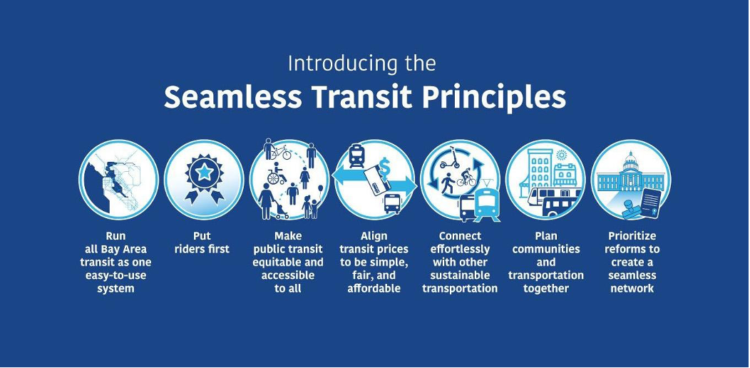
Public transportation in the Bay Area is broken, with 27 separate transit agencies operating with little coordination and without a regional vision.

Seamless Bay Area

Seamless Bay Area
2023 - $15,000 Integrated, Affordable Bay Area Transit Fares
2020 - $15,000 General Operating Support

Public transportation in the Bay Area is broken, with 27 separate transit agencies operating with little coordination and without a regional vision. As a result, transit riders in the Bay Area must navigate unreliable service, slow speeds, lack of connections, and confusing wayfinding information. It's no wonder only five percent of all trips in the Bay Area are on transit.

The Bay Area's lack of a connected, convenient public transportation system hurts everyone. It leaves many people with no option but to drive everywhere, spending more of their paycheck on transportation costs, and more of their time in long commutes. It’s bad for the economy, for equity, and for the environment. In addition, the COVID-19 pandemic has further weakened the region’s transit system, reducing agency budgets and leading to major service cuts that disproportionately impact transit-dependent people and essential workers. 

It doesn’t have to be this way. Seamless Bay Area was founded in 2017 with the goal of transforming the Bay Area’s fragmented and inconvenient public transit into a truly world-class, integrated, equitable system that connects people and communities across our nine-country region. Through research and thought leadership, public education and engagement, and grassroots advocacy, Seamless Bay Area is building a coalition of elected officials, transit leaders, riders, and advocates committed to changing the region’s transit system for the better. 

While transit operators across the country - including in the Bay Area - are currently facing the worst financial and operational crisis in a generation, there are also unprecedented opportunities to bring about transformative change. 

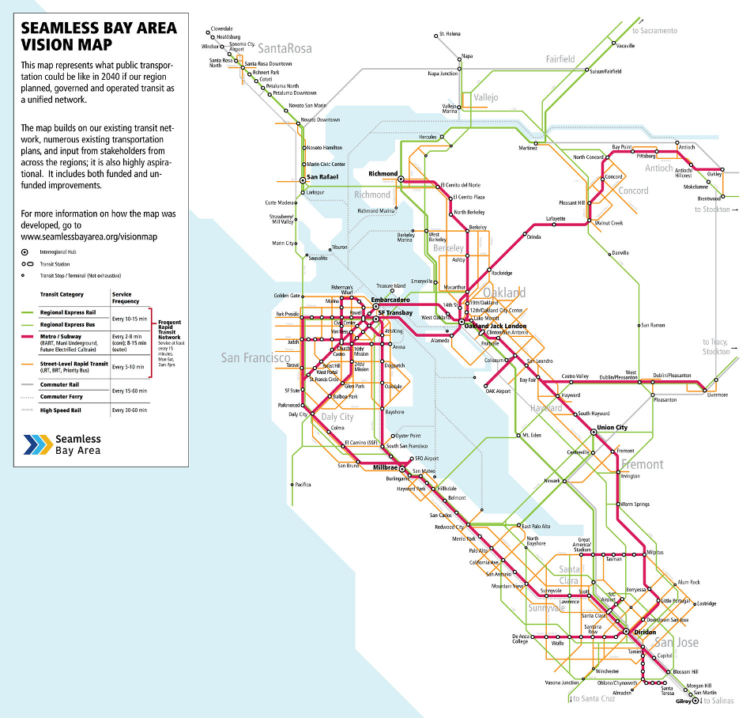
Seamless Bay Area’s original proposals, maps, and interactive tools are helping Bay Area leaders and community members understand how the region’s transit system could be improved, and galvanizing them to take action. 

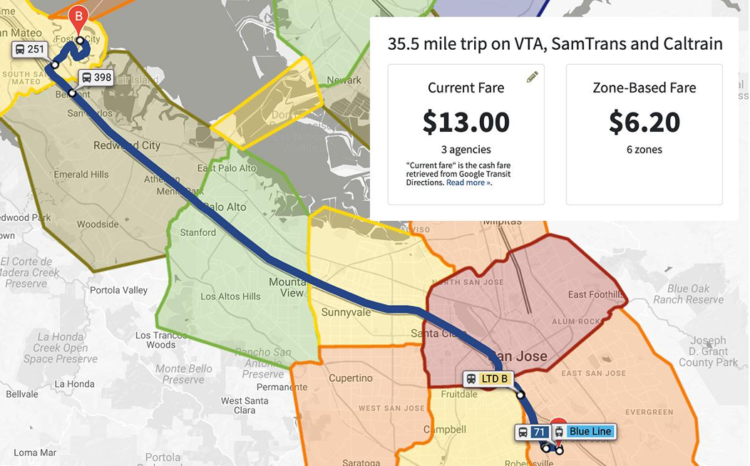
Segment of the Seamless Fare Vision interactive map showing cost savings from integrating transit fares.

Through regular public webinars, information sessions, networking events, and rider forums, Seamless Bay Area is educating the public, building broad support for transit improvements, and amplifying the voices and perspectives of transit riders. 

In 2019, Seamless Bay Area launched a set of seven Seamless Transit Principles to build support among members of the public, elected officials, organizations, and jurisdictions for integrated, rider-friendly transit. To date, the principles have been endorsed by over 35 organizations, including SPUR, TransForm, and Urban Habitat; by cities and counties representing millions of Bay Area residents; and by over 1,800 individuals.

Seamless Bay Area has also partnered with leading experts to conduct research on international best practices for well-coordinated, affordable, high-ridership transit systems, and educate transit agency leaders, staff, and policymakers on best practices.

Map illustrating the coverage area of regions around the world with high-ridership, well-coordinated transit systems.

Thanks to the group’s successful advocacy to date, in 2020 Seamless Bay Area was invited to serve on the region’s 32-member Bay Area Blue Ribbon Transit Recovery Task Force, a group convened for the purpose of helping Bay Area transit operators navigate and recover from the COVID crisis. Seamless Bay Area also serves on the region’s Fare Integration Stakeholder Group, which is shaping a regional Fare Coordination and Integration Study with the potential to make transit more convenient and affordable in the Bay Area for many years to come.

By articulating a clear vision for change and building a growing coalition of support among transit leaders, advocates, and the general public, Seamless Bay Area is uniquely well-positioned to lead the way toward the integrated transit system the region deserves.

Seamless Bay Area volunteers speaking to riders at a San Francisco Sunday Streets Event in 2019.

SF Transit Riders

2020 - $15,000 General Operating Support

SF Transit Riders

SF Transit Riders
2020 - $15,000 General Operating Support

Shared Use Mobility Center

2026 - $20,000 General Operating Support
2025 - $20,000 General Operating Support
2024 - $20,000 General Operating Support
SUMC’s vision is that ALL people have access to equitable, safe, reliable, and affordable transportation options, even if they don’t own a car.

Shared Use Mobility Center

Shared Use Mobility Center
2024 - 2026 - $20,000 General Operating Support

SUMC’s vision is that ALL people have access to equitable, safe, reliable, and affordable transportation options, even if they don’t own a car. (This is regardless of age, gender, race, ethnicity, religion, disability, sexual orientation, sexual identity, education, national origin, or any other distinguishing characteristic or trait.)

SUMC’s mission is to connect and equip change leaders advancing people-centered shared mobility systems to fight climate change, advance equity, and strengthen communities.

Current transportation systems prioritize cars over people, creating systems that are unjust, unsafe, and unsustainable. Car-centric infrastructure contributes to 20% of global greenhouse gas emissions and causes nearly 1.2 million deaths worldwide each year — disproportionately affecting people of color, older adults, and youth.

Across the country, mobility change leaders are working to build safer, more inclusive, and climate-resilient communities. But to scale their work and shift entire systems, these leaders often lack the capacity, resources, and connections they need.

This is where the Shared-Use Mobility Center (SUMC) comes in.

Founded in 2014, SUMC is a 501(c)(3) public-interest nonprofit and international thought leader in equitable transportation. The organization connects and empowers changemakers building people-centered mobility systems that reduce emissions, advance equity, and strengthen communities.

Through applied research, SUMC deepens the field’s collective understanding of how shared mobility can advance equity and sustainability and maintains several high-impact dissemination platforms to ensure these insights reach the sector.

As a capacity builder, SUMC delivers tools, training, technical assistance, and consulting services to help practitioners implement people-first transportation solutions. Pilots and projects supported by SUMC include innovative approaches to paratransit challenges; first/last-mile solutions; jobs access pilots; mobility hubs in affordable housing; EV carsharing in disadvantaged communities; and more.

As a trusted convener, SUMC brings together leaders from the public, private, nonprofit, philanthropic, and academic sectors to drive innovation and systems change.

Since its founding, SUMC has helped secure over $90 million for mobility innovation and served as a technical advisor on nearly 150 pilot projects nationwide. The organization has supported both public agencies and community-based organizations in transforming transportation from the ground up. Its body of work includes over 1,500 publicly available resources and tools aimed at empowering the sector.

SUMC is a long-term partner of the Federal Transit Administration (FTA) and has worked with the Federal Highway Administration (FHWA), the Transportation Research Board (TRB), and many public, private, and nonprofit clients.

SUMC’s vision is a future where everyone has access to safe, sustainable, reliable, and affordable transportation — even without owning a car.

sharedusemobilitycenter.org

Spring Street Climate Fund

2024 - $20,000 Clean Transportation
2023 - $15,000 Zero emission school buses
Spring Street Climate Fund runs strategic, effective campaigns to win transformative climate policy that helps people in concrete ways they experience directly.

Spring Street Climate Fund

Spring Street Climate Fund
2024 - $20,000 Clean Transportation
2023 - $15,000 Zero Emission School Buses

Spring Street Climate Fund runs strategic, effective campaigns to win transformative climate policy that helps people in concrete ways they experience directly. Using this approach, Spring Street acts as a force multiplier in the climate movement, bringing in new grassroots constituencies of New Yorkers with shared interest in Spring Street’s priority climate policies.

One of Spring Street’s priority campaigns is its work with New Yorkers for Transportation Equity: a powerful coalition of advocates, policy experts and grassroots partners that has come together to demand that elected leaders prioritize public transit, biking and walking and deprioritize cars and highways so that the state can meet its climate goals – and help people all over the state secure access to jobs, services and all of their daily needs.

In 2024, NYFTE launched its first coordinated campaign, the Get Around New York Act: a bold new framework to reduce car use and invest in clean, equitable mobility options for all. The coalition’s policy agenda will:

  • Reduce Vehicle Miles Traveled (VMT): The coalition’s proposed bill sets a statewide goal to reduce VMT by 20% by 2050, a crucial step to meeting New York’s climate targets and improving air quality.
  • Invest in Transit, Walking, and Biking: The NYFTE coalition is also working to require New York State to protect public investment in sustainable transportation at a pivotal moment for climate, access and mobility. 

Taken together, the Get Around New York Act will not only reduce the number of vehicle miles traveled in New York - it will also create an ambitious new roadmap for addressing one of the nation’s leading sources of climate-harming emissions, pioneer a model for state investment in sustainable modes of transportation, and accelerate the pace of climate progress around the country.

www.springstreetclimate.org

SPUR (formerly San Francisco Planning + Urban Research Association)

2023 - $20,000 Transit Oriented Communities
2021 - $15,000 Transit Priority Program
2019 - $10,000 Operational Landscape Units Project
2018 - $20,000 Regional Plan
2017 - $10,000 Operational Landscape Units Project (with SFEI)
2017 - $10,000 Framework for Sea-Level Rise Adaptation
2016 - $15,000 Framework for Sea-Level Rise Adaptation
2014 - $15,000 Fossil Fuel Reduction Report
2010 - 2014 $38,000 Food Systems and Urban Agriculture Program
2007 - $5,000 General Operating Support
Through research, education and advocacy, SPUR promotes good planning and good government in the San Francisco Bay Area over the past five decades.

SPUR (formerly San Francisco Planning + Urban Research Association)

SPUR’s We Are the Bay exhibition

Farmer’s market in San Francisco; photo credit Sergio Ruiz

Rising tides threatening to flood; photo credit Sergio Ruiz

SPUR’s How We Move exhibition

A transit + design workshop held at SPUR’s Urban Center

SPUR (formerly San Francisco Planning + Urban Research Association)
2023 - $20,000 Transit Oriented Communities
2021 - $15,000 Transit Priority Program
2019 - $10,000 Operational Landscape Units Project
2018 - $20,000 Regional Plan
2017 - $10,000 Operational Landscape Units Project (with SFEI)
2017 - $10,000 Framework for Sea-Level Rise Adaptation
2016 - $15,000 Framework for Sea-Level Rise Adaptation
2014 - $15,000 Fossil Fuel Reduction Report
2010 - 2014 $38,000 Food Systems and Urban Agriculture Program
2007 - $5,000 General Operating Support

Work

Through research, education and advocacy, SPUR works to create an equitable, sustainable and prosperous region. SPUR practices urban policy, developing and advocating for ideas and reforms to bring about systems change. The decisions that shape housing, transportation, land use, economics, food access, sustainability and resilience have significant impacts on people’s lives. SPUR also focuses on governance because it’s how communities organize themselves to achieve collective goals and because SPUR believes in the power of government as a force for good. SPUR works across the nine counties of the Bay Area because the structural systems that shape people’s lives- the housing market, the transportation network, the economy - are regional. SPUR does deep work in San Francisco, San José and Oakland because policies set in the region’s three biggest cities have widespread impact on most Bay Area residents and because local context is critical for effective policy. SPUR believes that community and individual well-being are healthiest when a society achieves equity, sustainability and prosperity. Equity because systemic racism continues to create unjust and unacceptable outcomes for many members of our community. Sustainability because human well-being depends on a healthy and thriving natural environment. And prosperity because meeting individual and collective needs requires resources. SPUR conducts its work through research, education and advocacy because these tools have the power to change minds and shape outcomes. The organization believes that profound systems change requires addressing beliefs, relationships and policies, and SPUR works at all three of these levels. SPUR grounds its work in a spirit of inquiry and a big-tent perspective that engages partners and communities across the region.

Goals

SPUR has many key goals related to each of the organization's major policy areas, including:
Planning: Add new jobs and housing where they will support equity and sustainability, and make neighborhoods safe and welcoming to everyone.
Housing: Make housing affordable for everyone.
Transportation: Make it fast, easy and inexpensive to get around without driving alone.
Sustainability + Resilience: Eliminate carbon emissions and make communities resilient to climate change.
Economic Justice: Enable all people to participate in the region’s thriving economy and attain economic security.
Good Government: Support a high-functioning public sector that serves the collective good.
Food + Agriculture: Create healthy, just and sustainable food systems, and put an end to food insecurity.

Achievements

SPUR has accomplished many things over the course of its 100+ year history. The organization shaped some of the most important planning and urban policy issues in the region, including planning for the BART system, establishing the Golden Gate National Recreation Area and the Bay Conservation and Development Commission, proposing San Francisco’s Affordable Housing Trust Fund and more. Recent achievements of the organization in 2020, include:

  • Crafting more than 70 policy recommendations on housing, transportation, planning, sustainability and resilience and more
  • Welcoming more than 13,000 individuals to public forums covering pressing issues in the Bay Area, such as the housing affordability crisis, economic inequality, how COVID-19 affects small businesses and more
  • Co-sponsoring three pieces of legislation passed by California lawmakers, including SB288, which expands CEQA exemptions to speed up the delivery of sustainable transportation projects in the state
  • Hosting the organization's first Ideas + Action symposium, which brought together public space experts and more than 1,500 attendees from across North America
  • Released numerous reports and white papers, on topics such as the future of transportation, transit project delivery, climate hazards and modeling future places, which envisions a Bay Area that can welcome everyone
  • Hosting a forum with Mayors Breed, Liccardo and Schaaf of San Francisco, San José and Oakland to learn how cities of the Bay Area can collectively work toward a more equitable, sustainable and prosperous region
  • Leading convening efforts for the new California Home Builders Alliance, an informal advocacy coalition focusing on state legislation and regulatory reforms to build more housing

Impact Report attached; our most recent annual report was online only--it is available here: https://www.spur.org/about/annual-reports/2020

spur.org

The Bike Kitchen

2011 - $3,000 General Operating Support
San Francisco’s Bike Kitchen teaches people of all ages and backgrounds how to repair bicycles.

The Bike Kitchen


The Bike Kitchen
2011 - $3,000 General Operating Support

San Francisco’s Bike Kitchen teaches people of all ages and backgrounds how to repair bicycles. Through bike repair and bicycle related projects, the Bike Kitchen promotes personal development and provides leadership opportunities. Operating as a cooperative shop, they provide affordable ways to acquire and maintain a bike, offer youth programs, encourage re-use and recycling, and work with community groups to get more people on bicycles. The Bike Kitchen is a 501(c)(3) non-profit run by volunteers.

bikekitchen.org

TransForm

2023 - $15,000 Survive and Thrive Transit
2019 - $15,000 General Operating Support
2015 & 2016 - $10,000 General Operating Support
For nearly eighteen years TransForm has helped envision and advocate for affordable, walkable neighborhoods with a wide variety of transportation choices to connect residents to health care, schools, shopping and work.

TransForm


TransForm
2023 - $15,000 Survive and Thrive Transit
2019 - $15,000 General Operating Support
2015 & 2016 - $10,000 General Operating Support

For nearly eighteen years TransForm has helped envision and advocate for affordable, walkable neighborhoods with a wide variety of transportation choices to connect residents to health care, schools, shopping and work. The Innovative Cities project plans to integrate new mobility options, such as car-sharing and bike sharing, into community development, with special consideration given to Oakland and San Jose. The GreenTRIP Connect program is developing a web-based interactive map that documents the economic, health and environmental benefits of on-site car sharing and bike sharing with free memberships, and free transit passes for residents.  

transformca.org

Transportation Alternatives

2026 - $20,000 General Operating Support
2025 - $20,000 Biking is Not a Crime
2024 - $20,000 Congestion Pricing
2023 - $20,000 20x20 Project
2022, 2024 & 2025 - $10,000 General Operating Support
2011 - $5,000 General Operating Support
Transportation Alternatives’ mission is to reclaim New York City's streets from the automobile, and to advocate for bicycling, walking and public transit as the best transportation alternatives.

Transportation Alternatives

Transportation Alternatives
2026 - $20,000 General Operating Support
2025 - $20,000 Biking is Not a Crime
2024 - $20,000 Congestion Pricing
2023 - $20,000 20x20 Project
2022, 2024 & 2025 - $10,000 General Operating Support
2011 - $5,000 General Operating Support

Transportation Alternatives (TA) works to reclaim New York City’s streets from the automobile and to advocate for better walking, biking, and public transit for all New Yorkers. Through grassroots organizing and strategic communication campaigns, TA advances infrastructure and policy improvements that prioritize people, create safer streets, and ultimately realize a more accessible, sustainable, and equitable city. TA engages thousands of stakeholders each year through its advocacy work, including community residents, peer nonprofit organizations, civic coalitions, business leaders, elected local and state officials, and government agencies. Their campaigns reshape streetscapes into safe places where people can walk, bike, meet, play, and participate in the variety of activities that make urban living healthy, vibrant, and dynamic.

In the past five decades, TA has made remarkable progress. Today, bike lanes ribbon up and down Manhattan avenues. Hundreds of thousands more ride a bike to work every day. The city is equipped with dedicated bus lanes, public bike share, and car-free park spaces that did not exist five decades ago. In just the last two decades, TA advocacy was responsible for the introduction of America’s first protected bike lanes and the world’s largest speed camera program.  TA lowered the citywide speed limit for the first time in 50 years, and introduced Vision Zero to New York City, an idea which then spread across the U.S. The same story is true of the federal Safe Routes to Schools and Safe Routes for Seniors programs.

The few who founded Transportation Alternatives recruited and multiplied, and now TA’s tent of supporters is packed with New Yorkers who regularly take action, make the case to public officials, and testify to the importance of TA’s mission. Each week, TA organizes local meetings, protests, rallies, petition drives, community gatherings and on-street actions to amplify voices. By the power of these people and a track record of transformative change, TA demands New York City’s most influential decision makers pay attention.

In that time, a remarkable subset of the organization was also born. Families for Safe Streets (FSS) is a coalition of people injured in traffic crashes, and the children, spouses, siblings, and parents whose loved ones have been killed. What began in 2014 as a small group of families in mourning has grown to a citywide force for change, and a national inspiration, with chapter organizations in 14 cities. Together, this powerful group of survivors tell their stories as an unignorable testament to the need for safe streets and refuse to give an inch in defense of the status quo.

From the creation of grand public spaces, like the pedestrianization of Times Square, to the construction of protected bike lanes and pedestrian plazas in all five boroughs, TA and FSS have paved the way for remarkable changes in New York City’s transportation infrastructure and transformed New Yorkers’ understanding of bicycling, walking and public transit.

transalt.org

Transportation for America

2023 - $15,000 Reduce VMT/zero emissions vehicles report
Smart Growth America (SGA) envisions a country where no matter where you live, or who you are, you can enjoy living in a place that is healthy, prosperous, and resilient.

Transportation for America


Transportation for America
2023 - $15,000 Reduce VMT/zero emissions vehicles report

Smart Growth America (SGA) envisions a country where no matter where you live, or who you are, you can enjoy living in a place that is healthy, prosperous, and resilient. SGA works across the nation with elected officials at all levels, real estate developers, chambers of commerce, transportation and urban planning professionals, and community members to improve everyday life for people across the country through better development. SGA’s team includes experts in land use, real estate development, transportation, and economic development.

SGA currently focuses on three specific priorities: Climate change and resilience, advancing racial equity, and creating healthy communities. Solving huge challenges like climate change, affordable housing, the need for vibrant local economies, or how to affordably connect people to jobs and services requires an interdisciplinary approach across a span of interrelated areas: housing, zoning, planning, land use, economic development, transportation, and others.

At the core of SGA’s overall approach is empowering communities through direct technical assistance, powerful advocacy, and thought leadership to realize our vision of livable places, healthy people, and shared prosperity.

We are known for path breaking reports like:

  • Driving Down Emissions, a report on the climate impacts of the transportation system that can and will undermine the benefits of electrifying the vehicle fleet if left untouched.
  • Dangerous by Design, which shows how the standard design of American roads lead to increased deadly mistakes and proposes ways to fix it in the nation with the highest level of roadway fatalities in the developed world.
  • Divided by Design, a report on the damaging effects of highways built through Black and Brown communities and how the approaches that led to this damage are still core to America’s transportation program today.
  • Electric Vehicles and Smart Growth, which looks at how we push transportation electrification in a way that supports essential smart growth goals since, the U.S. must remake our transportation and land use system to be less car-dominated at the same time that we electrify if we are going to meet our climate targets.

The organization also comprises a number of sub-brands, including Transportation for America, which focuses on creating a transportation system that connects people to jobs and essential services no matter how they travel, how much money they earn or their physical abilities. Our transportation priorities are to:

Transportation for America currently partners with the Clean Vehicles Coalition to manage the Coalition for Helping America for Rebuild and Go Electric (CHARGE) to decarbonize the transportation sector through both electrification and improving the efficiency of the transportation system to require less driving.

Transportation for America is currently examining the question: What balance of fleet conversion and reducing driving is needed to keep emissions low enough to stave off catastrophic global climate change? To answer this question, we will:

  1. Identify the total carbon budget to keep global warming below 2 degrees Celsius and calculate transportation’s share of that carbon budget based on its current share.
  2. Develop several scenarios that meet that carbon budget with different levels of driving-reduction and fleet transition.
  3. Examine the costs and impacts of each of those scenarios to gain insight into the trade-offs of different approaches.
  4. Explain the results graphically.

t4america.org

Tri-State Transportation Campaign 

2025 - $20,000 Congestion Pricing and General Operating Support
2025 - $20,000 Clean Rides Network
2024 - $20,000 Congestion Pricing
Tri-State Transportation Campaign (TSTC) has been the leading watchdog for the region’s transit network, fighting to reduce car dependency and ensure an equitable, climate-resilient future for New York, New Jersey, and Connecticut.

Tri-State Transportation Campaign 

TSTC’s Summer Transportation and Environmental Justice Fellows tour the Second Avenue Subway and discuss the importance of congestion pricing funding for the project.

TSTC staff at the Congestion Pricing defense rally with Governor Hochul and advocates, 3/21/25.

Jaqi Cohen, Director of Climate and Equity Policy overjoyed at the Congestion Pricing defense rally with Governor Hochul, 3/21/25.

Photo by Jaqi Cohen

TSTC Board Chair Justin Balik speaks with Rocco Vertuccio on NY1 about Secretary Duffy’s made-up deadline for congestion pricing and why the MTA remains on solid legal footing.

TSTC Board Chair Justin Balik speaks with Rocco Vertuccio on NY1 about Secretary Duffy’s made-up deadline for congestion pricing and why the MTA remains on solid legal footing..

MTA’s promotional billboard for Congestion Pricing over the Astoria-Ditmars subway
station in Queens. Photo by Jaqi Cohen.

Elected officials, advocates, and supporters of congestion pricing gather on the one-year anniversary to celebrate the program and share new reports with the press.

Tri-State Transportation Campaign 
2025 - $20,000 Congestion Pricing and General Operating Support
2025 - $20,000 Clean Rides Network
2024 - $20,000 Congestion Pricing

Since its founding in 1993, the Tri-State Transportation Campaign (TSTC) has been the leading watchdog for the region’s transit network, fighting to reduce car dependency and ensure an equitable, climate-resilient future for New York, New Jersey, and Connecticut.

The decade-long battle for congestion pricing—the first program of its kind in the U.S.—reached a fever pitch in late 2024. When New York’s Governor Hochul unexpectedly paused the plan just weeks before its launch, TSTC spearheaded a massive pressure campaign. This advocacy was decisive: on January 5, 2025, the program officially went into effect.

While the base fee was adjusted to $9, the program is already delivering on its promises. In its first year, Manhattan’s Central Business District saw 80,000 fewer daily vehicles, a 22% drop in air pollution, and billions in revenue secured for critical MTA upgrades. TSTC continues to defend these wins against federal opposition and regional litigation, using data-driven analysis and innovative media—including their latest public engagement video—to ensure these benefits remain permanent.

tstc.org

Vision Zero

2025 - $20,000 Underserved Communities Traffic Violence
2017 - $10,000 General Operating Support
Vision Zero Network is a nonprofit project working to advance Vision Zero - the goal of zero traffic deaths or severe injuries.

Vision Zero


Vision Zero
2017 - $10,000 General Operating Support

Vision Zero Network is a nonprofit project working to advance Vision Zero - the goal of zero traffic deaths or severe injuries. Since its inception in 2015, it has helped grow the number of US communities committing to Vision Zero from 3 to more than 45. In addition, mainstream awareness of and support for the goal of safe mobility for all has grown significantly amongst elected leaders and policymakers, advocates, community members, and the private sector.

Traffic crashes cause 40,000 preventable deaths each year in the US and millions more serious injuries. And amongst youth, traffic crashes are the leading cause of death. This translates to 100 people losing their lives every day simply while walking, biking, riding transit, or driving. This equates to a mid-sized plane crashing every day, killing all passengers on board, which would certainly garner attention. But, most people are complacent about the tragedy of our daily death traffic toll.

Some communities are disproportionately harmed by traffic crashes in the US, including: children and seniors, people walking and bicycling, people of color, and low-income community members. When we factor in the health impacts of lack of physical activity due to overreliance on cars and auto-focused land use, as well as the pollution-related health impacts of motor vehicles, the already-staggering death toll of our car culture increases exponentially.

Vision Zero Network advances the goal of safe, healthy, equitable mobility for all people nationwide, whether walking, bicycling, riding transit or driving. As a learning network, they develop and share best practices, research and strategic communications. And, as an action-based campaign, they set milestones for success, help ensure accountability, elevate champions and raise public awareness. Their work includes facilitating peer exchange amongst community leaders and public sector staff leading traffic safety work on the ground, including public health and transportation professionals, policymakers, and community-based advocates. And by developing and sharing resources and setting up learning opportunities amongst peers, they help communities share promising strategies and lessons learned to advance Vision Zero. 

The Vision Zero framework treats traffic safety as a public health issue deserving of greater attention, support, and resources. Vision Zero is predicated on the understanding that these tragedies are not inevitable, but rather that we can make progress in safety by focusing on the upstream factors that influence people’s actions, particularly road design that accommodates all users and policies that prioritize safety over speed, including how speed limits are set. 

Vision Zero Network supports US communities in taking a systemic approach to reduce traffic deaths & severe injuries among all road users. Vision Zero is a new way of thinking about - and acting on - the need for safe mobility. It is both a goal and a strategy and represents a shift in three ways: First, it acknowledges that traffic deaths are preventable. Second, it is an interdisciplinary approach, coalescing diverse and necessary stakeholders to address a complex social problem. Lastly, Vision Zero is a data-based approach.

With Vision Zero, people across the nation are stepping up to declare that “Enough is enough” of the preventable loss and tragedy on our streets, sidewalks, and bikeways. Community members, mayors, transportation and public health professionals, police officers, and others are declaring that zero is the only morally responsible goal to set for safety.  They are acknowledging that we can prioritize safety while still ensuring mobility in our communities: This is a political choice. Slowly, but surely, we are seeing Vision Zero communities challenge the old paradigm that speed (or perception of speed) trumps safety.

The only acceptable goal for deaths on our streets, sidewalks, and bikeways is ZERO.

Seed Fund generously supported Vision Zero Network efforts to improve prioritization of racial and economic equity in traffic safety work. Staff focused on building knowledge, partnerships, and a long-term strategy toward centering equity in Vision Zero work. This included participation in national convenings on equity and policy implications.  In addition, they served as a resource to Vision Zero cities on this critical topic of how to ensure both effective and equitable strategies and outcomes in Vision Zero work growing around the nation. Examples of work in this area include development and sharing of resources such as “Equity Strategies for Vision Zero Practitioners” and educational webinars bringing together traffic safety leaders with racial and equity justice leaders. This has led to development of relationships and partnerships with leaders in the racial justice/transportation field and greater racial diversity on the VZ Network’s Advisory Committee. Longer-term, Seed Fund’s investment has supported the development of Vision Zero Network’s equity series, bringing together Vision Zero peers from around the country to discuss and develop traffic safety alternatives to promote both effectiveness and equity.

visionzeronetwork.org

Walk San Francisco

2023 - $15,000 Climate Justice in the Bayview
2021 - $10,000 20mph Speed Limit in the Tenderloin: Data Study
2016 - $10,000 Green Connections
2014 - $10,000 Vision Zero
2013 & 2022 - $10,000 General Operating Support
2012 - $6,000 General Operating Support
Walk San Francisco speaks up for safer, more pleasant streets for everyone to walk on.

Walk San Francisco

Mayor London Breed, State Senator Scott Wiener, Walk SF executive director Jodie Medeiros, and children from El Dorado Elementary School get ready for the 2019 Walk & Roll to School Day. Photo: Greg Zeppa

Walk SF was part of an action on Market Street pushing for permanent removal of private vehicles. 500,000 people walk on Market Street every day, and five of the city’s top ten most dangerous intersections are on Market. Photo by Walk SF.

Walk SF was part of an action on Market Street pushing for permanent removal of private vehicles. 500,000 people walk on Market Street every day, and five of the city’s top ten most dangerous intersections are on Market. Photo by Walk SF.

Walk SF was part of an action on Market Street pushing for permanent removal of private vehicles. 500,000 people walk on Market Street every day, and five of the city’s top ten most dangerous intersections are on Market. Photo by Walk SF.

At a March 2019 action on the steps of City Hall to shine a light on recent traffic fatalities. Photo by Walk SF.

A memorial to the lives lost in traffic crashes in San Francisco since January 2014. From the 2020 World Day of Remembrance for Road Traffic Victims. Photo by William McLeod with permission from Walk SF.


Walk San Francisco
2023 - $15,000 Climate Justice in the Bayview
2021 - $10,000 20mph Speed Limit in the Tenderloin: Data Study
2016 - $10,000 Green Connections
2014 - $10,000 Vision Zero
2013 & 2022 - $10,000 General Operating Support
2012 - $6,000 General Operating Support

San Francisco can and should be the safest, most walkable city in the United States. Yet every day, at least 3 people on average are hit by cars while walking in our city.

Walk San Francisco exists to change this. Walk San Francisco (Walk SF) was founded in 1998 by a small group of volunteers united by the belief that the city’s streets and sidewalks should be safe and welcoming for all.

Today, Walk SF is known as a tireless advocate in pushing for - and winning - life-saving changes across the city. Some defining wins include: 15 MPH speed zones around 181 schools; San Francisco’s second-in-the-nation commitment to Vision Zero; the removal of private vehicles from Market Street; the tax on Uber and Lyft; and groundbreaking changes to some of the city’s most dangerous streets.

Walk SF also founded and supports San Francisco Bay Area Families for Safe Streets, a group of traffic crash survivors and the loved ones of people who have been killed or injured in traffic crashes. Members offer emotional support and work together to win changes to prevent more lives from being destroyed by traffic violence. Each November, Families for Safe Streets and Walk SF hold World Day of Remembrance for Road Traffic Victims

In addition, Walk SF works to increase the number of children safely getting to school on foot, bicycle, scooter, and transit as part of the San Francisco Safe Routes to School Partnership. Walk SF also brings together the voices of the 30+ community-based organizations, nonprofits, and civic groups that make up the Vision Zero Coalition, plus leads the Senior and Disability Work Group. And throughout the year, Walk SF offers a variety of walks to both explore the pure joys of exploring the city on foot and the challenges faced due to unsafe streets.

In 2019, Walk SF launched its first-ever three-year strategic plan. The long-term goals outlined in it are to: 1) end pedestrian traffic deaths and severe injuries, and 2) increase the number of trips people take on foot.

As part of the strategic plan, Walk SF prioritized both what it works on and how it will work. Crash data shows that San Francisco’s residents living in communities of concern suffer the most from traffic violence. These are communities with the most low-income people, immigrants, communities of color, seniors, children, and people with disabilities. That is why while Walk SF works in the interest of all pedestrians in San Francisco, Walk SF prioritizes its efforts on communities and/or geographies where issues of equity are most at play.

Walk SF also focuses its outreach and education in communities and populations that have disproportionately been impacted by traffic violence and often not engaged in the community process. Walk SF works hard to ensure a community’s voice is authentically brought forward to guide advocacy efforts, and build coalitions across diverse communities. That’s why Walk SF goes much deeper in its community engagement and advocacy work in neighborhoods like the Tenderloin, where traffic violence is a daily reality for the nearly 40,000 people who live there.

Walk SF’s vision is for a San Francisco where everyone - of every age and ability - can get around safely. And the benefits of making this vision a reality ripple far beyond the precious lives that will be saved. When it is safe and inviting for many more people to walk in San Francisco, it also means reducing climate emissions. It means thriving neighborhood businesses and greater health. It means changing the fact that people of color are more likely to live, work, and walk on dangerous streets. It means stronger and more connected communities.

A memorial to the lives lost in traffic crashes in San Francisco since January 2014. From the 2020 World Day of Remembrance for Road Traffic Victims. Photo by William McLeod with permission from Walk SF.

At a March 2019 action on the steps of City Hall to shine a light on recent traffic fatalities. Photo by Walk SF.

walksf.org